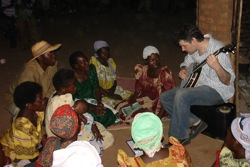
RockOm: You've just wrapped up the tour supporting your
African Project: Throw Down Your Heart
. What did your time spent working on this project - both in Africa as well as your time touring with these musicians - teach you about music’s ability to bring people of different cultures together?
Bela Fleck: It was a wonderful experience and I believe I will feel the repercussions for the rest of my life. It changed my musical worldview and opened my horizons.
RO: What will you miss most and reflect back on after your time with these great African artists is over and you move on to new projects?
Bela: The great relationships I have made with such great musicians are very special. I will miss these guys. But I plan to keep the doors open and see where the road leads.
RO: What should listeners expect from the upcoming CD with Zakir Hussain, Edgar Meyer and conductor Leonard Slatkin?
Bela: It is an interesting project for several reasons. There is the ambitious triple concerto that we wrote, which is my first recording with an orchestra. Then there are the six trio pieces that we wrote, which is a much more intimate relationship. Then there is the weaving of the trio music and the concerto, which flows together in a cool way. We pulled some themes out of the concerto and developed them differently. This connects the orchestra music with the trio music and makes for a very satisfying unity.
RO: Zakir Hussain spoke with us about the special soul connection that is made with certain musicians, thereby setting the stage for long term relationships. How do you feel about the spirit uniting you with Hussain, as well as Edgar Meyer, and do you approach performing with these two artists differently than with others?
Bela: I felt so comfortable playing with Zakir. And Edgar is virtually my brother. So Zakir freshens our relationship in an incredible way and inspires with ideas that are new to us. Plus he is a groovin' dude, and I love to groove...
RO: Abigail Washburn is such an inspirational artist and performer with a distinct spirituality, which she shared with RockOm in our interview last year. As a part of The Sparrow Quartet (alongside Washburn, Ben Sollee, and Casey Driessan), what did you take away from the group's multiple tours of China and Tibet, promoting an exchange between East and West?
Bela: It also expanded my worldview, replacing my images of what these places would be like with actual experiences. I learned music from the Chinese, Tibetans and my fellow Sparrows. It was incredible to be in Tibet with the two governments working together.
RO: Lastly, keeping in mind the Christianity of Bach and bluegrass music, the Buddhism of Tibet, and the Hindu roots of Zakir's tradition - and since you've played in or with these different genres and styles - what are your general thoughts on how faith and religion serve and influence music?
Bela: I think music can be its own religion sometimes! I respect everyone's views and keep mine to myself and a few friends.
RO: Does music inherently call forth our better selves and sever the distinction between creeds or faiths?
Bela: It certainly can. These types of collaborations can bring out that very positive aspect. However it can also be used in a negative way, so beware the awesome power of music.
MORE INFO:
Bela Fleck recently wrapped a tour (8/12) with Toumani Diabate from the African Project: Throw Down Your Heart. He will be performing with RockOm alum Abigail Washburn on August 27-31 in Tonder, Denmark as part of the Tonder Music Festival. Beginning September 13, Fleck, along with Edgar Meyer & RockOm alum Zakir Hussain, will be touring and performing new music from their upcoming CD along side with their innovative "Triple Concerto for Banjo, Tabla and Double Bass". Beginning October 11 Bela Fleck and The Flecktones begin a month long tour. In early 2010 Bela Fleck and The African Project will be back out on the road. For more information on these concerts and dates please see
Belafleck.com
.
We couldn’t let the week go by without briefly mentioning that it’s RockOm’s first anniversary. A year ago we set out with an intention to serve others through music and along the way we discovered something extraordinary - the music we were presenting began serving us, changing us for the better in ways far beyond our wildest expectations.
Our very first interview was with bluegrass legend Ricky Skaggs wherein he spoke about the power of music to change people. There is no other force like music that can reach out, create unity among different people and cultures, and heal souls as music does. In that way, music is quite literally
prayer
. Thousands of years ago prayers were sung so they would be remembered and passed along to future generations. The music we’ve been fortunate enough to present to you over the last year has found its way into our being and has become part of our prayer and our meditation.
We want to thank the many gifted musicians and artists we’ve worked with over the past year. To those artists such as Ricky Skaggs, Zakir Hussain, Abigail Washburn, Ram Dass, Krishna Das, The Blind Boys of Alabama, Steven Halpern, Futureman (Roy Wooten), Chuck Leavell of The Rolling Stones, Trevor Hall, Jai Uttal, David Newman (Durga Das), the late Ms. Odetta, The Wailers’ Aston "Family Man" Barrett and so many others who have opened their homes and their hearts to us we say thank you. To each of the "break-out" artists we've help introduce in our Featured Track of the Week spot, we say thank you. We also want to acknowledge the support and management as well as the PR people behind the artists who allow us to connect and bring each new feature and interview to you. Finally, we can’t leave out the many guest writers who have lent us their reviews, interviews and stories making for compelling reading on matters of music and spirituality each week. We want to thank our families as well for supporting our many long hours of work and believing in our love of the power of music.
Lastly, we want to thank you - you who are reading these words right now. We created RockOm for you and we hope, perhaps in some small way, you have been blessed and changed for the better through the power of music.
Happy Tuesday! Just as if it were your birthday, you get two new gifts today - you lucky thing!
First off is the enjoyment of listening to a brand new Featured Track of the Week - this time from New York-based jazz trio Transcendence. See the right panel of the home page to listen to their track "The Seventh House" throughout the next week. You'll also want to follow the link to their myspace page, listen to other tracks and purchase the newly released album.
Secondly, we've published
a new podcast
featuring the raw audio of this month's interview with the Sparrow Quartet's Abigail Washburn. Listen in as RockOm's Tom Crenshaw shares an intimate conversation with Abigail as they discuss her career and enlightenment along "the disciplined path."
Today we're happy to announce the launch of RockOm's August content including some brand new Featured Interviews from
Trevor Hall
,
Abigail Washburn
,
Ken Block
(from Sister Hazel) and part II of RockOm's interview with
Futureman
.
You'll also want to check out our new Featured Track of the Week from Shahram Shiva (on the homepage). We'll keep this short and sweet so you can spend some time reading and exploring. Leave some comments and get the conversation going!
Abigail Washburn is the unofficial leader of a bluegrass, alt-country/classical, Chinese-folk Super Group called The Sparrow Quartet featuring cellist Ben Sollee, Grammy nominated violinist Casey Driessen, and multi-Grammy Award Winner Bela Fleck. Abigail also performs with a group called Uncle Earl. Between the two bands Abigail keeps herself busy traveling the world touring such exotic lands as China and Tibet.
Abigail Washburn and The Sparrow Quartet’s self titled CD is out on the Nettwerk Productions label and features 13 tracks rich in diversity and soothing to the soul. The group is currently touring in the U.S. In August The Sparrow Quartet will be touring China during the Olympic Games. RockOm's Tom Crenshaw met up with Abigail in Savannah, GA earlier this year at The Savannah Music Festival.
RockOm: You covered a lot of territory in your 29 years. You’ve lived throughout the U.S. and have traveled to exotic lands and have performed with two acclaimed bands: Uncle Earl and The Sparrow Quartet singing everything from gospel to reggae to country, bluegrass- even Chinese folk music. What is it that brings all that together for you? What’s the common thread running through all your musical experiences, and how do you explain your success?
Abigail Washburn: That’s a big question there [laughs]. I have a good friend who’s in the 5th grade and she was doing a project and she sent me a bunch of questions for her project. She was sending them to me and some dear friends like Alison Krauss to get all our perspectives on what it means to be women connected to traditional music. Her first question was: “Why do you play music?” [Laughs]. At first I was like, “Oh no! I thought this was the kind of question she would send me” and I thought, “What a profound question.” Nobody ever asks me that anymore. Everyone thinks they have to ask this really nuanced question that lays out the preface for a story but, she just asked it point blank, “Why do you play music?” And I feel like this is what you’re asking, in a round about way- with a bit of flavor.
I suppose the reason I sing and sing all those different styles is because I have a need to communicate. To reach outside of myself and try to express the colors and the sounds that I feel inside and share them with the world, hoping that maybe in the act of communication, there will be a bond that makes it all more meaningful. Sometimes there are certain feelings that arise, just from being human, that are so consuming and so profound that it feels like unless I communicate them I might drown in them. And so, if I can just share that feeling, that emotion, that depth and profound feeling of just being alive, I feel like I’m more likely to feel a connection not only to mankind but to a broader sense of humanity that lets me remove myself from my own sense of the world to something greater and that, in fact, takes me to a sense of divinity.
I think it's connection through our brethren that leads us to a sense of divinity because we can actually pull outside of ourselves and it’s that first step of communication that takes us to a place that’s open to the divine powers. That’s my sense of why I play music--to share, to communicate, to connect, to open that channel to something outside myself that ultimately is targeting the divinity of life.
RO: Who inspires you? Who feeds your soul and inspires that divinity in you musically?
Abigail: Every moment. Every moment does [laughs]. There’s not a moment that goes by that isn’t as poignant as the next. But, to get more specific, I think there’s a broad community of people that I find myself interacting with in the folk community and the Chinese music community. Then there are the recordings and the personalities, personas over time that I’ve fallen in love with, like Mahalia Jackson. Bruce Springsteen’s
Nebraska
is one of my favorite albums. The list goes on and on. There’s a bunch of old time music, living and dead musicians that inspire everything I do. I love old blues so much…old blues and gospel traditions are my favorite, especially African American gospel traditions.
RO: Tell me about first hearing Doc Watson.
Abigail: Well Doc Watson, for me, was the epitome of something uniquely, beautifully American. As soon as I heard Doc Watson I felt I had my antidote- it was the answer to what was beautiful about America, what made me fall in love with America once I became an adult. When I was 18 years old, I went to China for the first time. I fell deeply, madly in love with this other culture and realized I didn’t know that much about my own, from an objective point of view. So, when I came back to the states, I was subconsciously, probably even consciously looking for something American to turn me on to, to excite me, to make me want to say I’m American- and in one sense I found that, and, in another, I found that culture is a very universal thing: the Chinese say, “all music is universal language.” Music expresses the entirety of what it means to be human: our joys, our sorrows, our suffering and our gladness. No matter what music you’re hearing, you’re hearing all of that.
So, I’ve come back around to that… but, Doc Watson got me really excited about American Music. It’s that subtle and yet, overt combination… well, you know- subtle in America and overt when you’re in the rest of the world- that combination of the Irish and Scottish cultures mixing with the African cultures in the very beginnings of American culture. I feel like you can hear that really distinctly in Doc Watson’s music.
RO: You were in China in 2005 and 2006 with The Sparrow Quartet and in 2006 you also toured Tibet. You were doing your bluegrass, country type sound over there and discovering there’s something similar [between bluegrass and Chinese folk music]. How does music transcend cultures?
Abigail: I suppose it has a bit to do with what I said earlier with the general idea that music is a universal language. Music for me is about expressing and hearing the sensory world of individual human beings and finding that common thread, that connection. There are two levels on which I can answer your question: one is the technical aspects of what instruments we play, what they sound like together, whether or not our languages sound good being sung together and what the lyrical content is. That’s sort of a more superficial way to approach that question. It’s also a meaningful way to see what’s happening, but I think on the most profound level, we’re all expressing what it means for us to be alive.
Specifically, with instrumentation- when the Sparrow Quartet sits down with a band of Chinese musicians, especially if it’s acoustical oriented music, there are certain limitations based on the fact that we’re playing three to five- stringed instruments, lutes and bowed instruments basically. There’s only so much the instruments can do…and when I sit down to play with Chinese folks, it kind of comes down to, “what’s possible here?” Can we get in the same tuning… or close enough? Can you chord your instruments so that we’re slightly in tune, even? Most times we’ve been able to make that happen, especially with musicians with a fine ear. There are different combinations; there’s where you’re playing with musicians that really can’t come to you- you have to change your approach to go to them. Then, it can be reversed. The most beautiful place is where you can meet in-between and you figure out a way to create something new together. Something at embodies both of your personalities, your cultures, who you are as a human and who you are as a representative of a certain culture… and if all that can come together at once that’s magic!
RO: What’s the most enlightened musical moment you’ve ever experienced?
Abigail: Enlightened? [very long pause]
RO: Is there something that happens on stage with you? You’re with some great musicians in The Sparrow Quartet. Do you ever find yourself amazed that you’re here at this moment on stage doing something you love to do and say, “wow, this just blows my mind?”
Abigail: That happens all the time! [laughs]
RO: Would you consider that spiritual for you- is there an enlightenment quality to that, to realize you’re doing what you want to do? As Joseph Campbell said, you’re following your bliss.
Abigail: I think there’s kind of two ways and maybe I’m going to regret saying this later, but I think there are two ways to an enlightened sensibility and possibly even enlightenment. One is surrender; surrender in any moment to the possible and the impossible, to admit that at any moment that this box is not a limitation. There’s another thing that I think humanity generally needs in order to feel and sense enlightenment. This is a disciplined path: a path of discipline that clearly gives results that then leads to further discipline then leads to more results. That ultimately gets us closer and closer to some kind of sense of nirvana or this ultimate goal, even though we may never reach it. I most often find myself on the path of discipline and trying to take the form that I envision being bliss.
The way one of those [two] moments can be summed up, similar to what you were saying at the very beginning of your question, is with The Sparrow Quartet, there’s very complex patterns being over laid on top of each other. Some might not think their very complex, but, for me, they are. The act of memorizing and repeating those patterns over and over again to the point where there’s an intense comfort with something that was extremely uncomfortable just a month before… there’s a sense of mastery and possibility through discipline when that happens. If that can line up in a show in front of however many people, if it can line up on the stage in that moment, the pattern is so ingrained that I can release myself to it and the emotion that was intended in the writing of the lyric and feel a freedom because the pattern is so sturdy, that it flows. It’s like a channel that burst open and the patterns become like a heaving organism that is inner connected. There’s just no way anything could go wrong.
I’ve had that happen a few times now with The Sparrow Quartet and I predict that in the next month or two of touring (We’re in the very beginning phase of touring and our playing of this music, especially in front of an audience), it will feel like this throbbing, heaving organism that takes on a life of its own, and I’m not thinking so much about the pattern. I’m expressing what the pattern was put in place to support.
RO: You’ve done so much in your 29 years. Will you still be playing music in 10 years?
Abigail: I hope so. I don’t think that’s so much up to me. On one level, I believe in fate, on another, I don’t. I think the fact that I’ve gotten to where I am now feels like a miracle. It feels like an act of grace… and I feel like if I can continue to let myself be open to grace and the possibility of miracles, then I don’t know where I’ll be in 10 years. And, I wouldn’t want to predict it. But, I feel awfully good about what I get to do right now- it feels like an honor. It feels like an extreme honor, but I’ve got to say that I think every being’s existence is outrageously important. So, I would never say that I think that this would be better than anything else I could do. So, I’ll wait for the next signs and do my best in the meantime.

 RockOm: You've just wrapped up the tour supporting your
African Project: Throw Down Your Heart
. What did your time spent working on this project - both in Africa as well as your time touring with these musicians - teach you about music’s ability to bring people of different cultures together?
 We couldn’t let the week go by without briefly mentioning that it’s RockOm’s first anniversary. A year ago we set out with an intention to serve others through music and along the way we discovered something extraordinary - the music we were presenting began serving us, changing us for the better in ways far beyond our wildest expectations.
 Happy Tuesday! Just as if it were your birthday, you get two new gifts today - you lucky thing!
 Today we're happy to announce the launch of RockOm's August content including some brand new Featured Interviews from



 Email Us!
 RockOm RSS Feed
 RockOm Facebook
 RockOm MySpace
 RockOm Twitter
 RockOm YouTube
 RockOm Viddler


