viagra online ordering viagra online without a prescription

Posts Tagged ‘Africa’

RockOm Round-up

Monday, August 31st, 2009

RockOm Round-up is a quick glance at what's going on around the world in the areas of music and spirituality...

  • Swing, Africa, Swing! - "To say that music is a part of life in Africa is an understatement. In many African cultures, music has a greater significance than human life. It is often believed to have predated the existence of man and remains the main conduit for communication with gods. With this emphatic beginning, author Graeme Ewens plunges us into a fascinating journey into the world of African music." (thepatrioticvanguard.com)
  • Sing your stress away - "Whether singing in the shower, the car, with a choir or a small child, “sound therapy” is linked to health benefits for body and spirit. Since ancient times singing has been considered a healing tool especially chanting and we all know that countries have created national anthems to generate patriotism. Sound can influence brain wave frequencies and promote well-being by doing the following..." (examiner.com)
  • Healed by the power of music - "It is one of the most remarkable and inspirational stories in music: how Philadelphia singer-songwriter Melody Gardot rose from a near-fatal car accident five years ago to become one of the biggest jazz artists in the world. How she got there is a story of perseverance, hope and the healing power of music. Not only did music enable her to walk and talk again, it has set her up with a career many would crave." (news.yahoo.com)
  • Questing After Coltrane’s Messy Transcendence - "The dauntless, combustible energies of jazz’s 1960s avant-garde have long held a deep attraction for the guitarist Marc Ribot. His public profile may involve a great deal of tact and concision — he works widely as a gun for hire, often infusing low-gloss pop albums with a proper hint of twang — but as a bandleader he tends to reach for a messier, more transcendent ideal. In recent years he has expressed that impulse best through his band Spiritual Unity, inspired by the free-jazz firebrand Albert Ayler." (nytimes.com)
  • Old Faith Innovates in a New Land - "About 50 singers had gathered on Sunday morning in the senior center across the street from the Ganesha Temple, operated by the Hindu Temple Society of North America, in Flushing, Queens. They would be performing on the busiest day of the temple calendar — the first day of the festival dedicated to Ganesha, the elephant-headed god." (nytimes.com)

Julian Marley Urges ‘Awake’ on Third Album

Monday, June 1st, 2009

by Mel Cooke, The Gleaner, Jamaica W.I.

Jacob Marley Though primarily a roots reggae album, Julian Marley delves into several other genres on his latest project, Awake .

On the album, due out May 26 through Ghetto Youths/Universal, there is a marked difference between the feel of two adjacent songs on the same topic, the slow, bare-bones (musically) "Just In Time", which is followed by the up-tempo reggae piece, "Jah Works". Both deal with the spirituality of the Rastafarian. Marley tells The Sunday Gleaner that the tempo for "Just In Time" was decided when the song was being constructed.

"Songs like that don't need a whole heap of instruments. It is a more organic sound. It is a desolate sounding song. Jah Works now, more upbeat, more in the reggae beat," he says.

Variations in tempo and vocal timbre are part and parcel of the album, the title track of which was the first that Marley came up with. (He points out that it took him two years from conceptualization to completion, but he was not "really consistent right through" the entire 24 months.) So he started out with the love song, "Oh Girl", featuring rapper Mr Cheeks, with a brief monologue in a deep voice and quickly goes into a good falsetto. "Boom Draw" is an out-and-out rub-a-dub tune, while "All I Know" is a hip-hop one.

Every little thing

Still, most of Awake is on familiar roots reggae ground. "Me is a man listen most of the legendaries," Marley says, adding that he listens to jazz, the blues and "every little thing".

"But when it come down to the roots we want to have it original," he said. And that means reggae rockers. "Jamaica has a history of reggae, just like America have a history of the blues. If you go to a blues show in America is like you are in the '50s. So me no care, me come fi deliver the roots and create it with live music." He can play a lot of that live music, as he plays the guitar, keyboard, bass and drums. The guitar is the accustomed composition tool, although he chuckles as he says if he had a keyboard with him he would probably write more songs.

Another pair of adjacent, thematically similar songs is "Rose Hall" and "A Little Too Late" (featuring brother, Stephen Marley). Both are about relationships where the male gets the bitter end of the stick. Marley says while they are not about his personal experiences, other persons he knows have been through them. They are in part intended for the men "to wise up. If you love a woman love her, but you can't lose yourself".

And while "Rose Hall" is not about the notorious Montego Bay lady, Marley says she is "one of the headliners. It is a lineage of people. It no have no colour either".

He is not looking askance at The Bible either, as in "Jah Works" Marley mentions Noah and the ark, as well as a pillar of salt. There is no conflict of spirituality here, as Marley says "of course Rastafari is biblically based. In The Bible, it speaks of the east. It may not say Ethiopia, but if you do your math ... Christ a go come in a new form," Marley said, referring to the King of Kings and Lord of Lords. "As we live the prophecy reveal in front of our eyes."

Discrimination

"Violence in the Streets" features another brother, Damian 'Jr Gong' Marley. Julian sings about the youths who "say them can't gat a job/'cause they got no credential", while Jr Gong deejays about the youths being discriminated against because of their hair like wool. Julian says the song is about the plight of the youths in general.

"We represent the African children wherever we are. The wool is not necessarily the locks. Everyone have the wool same way. But we can use that song to represent Jamaica 'cause is nuff African brethren. This song is a very serious song. If me go England is the same thing," Marley tells The Sunday Gleaner.

He considers unemployment the beginning of violence.

"You can't eat no food, everything goes upside down. If you can't feed your youths, it gets bitter," he said. Still, he points out that "it is also a mentality that get us lazy along the way. Even if you get an opportunity, you been doing nothing for so long". He describes "All I Know", which uses the familiar image of the bucket going to the well repeatedly as a "parables kind of song", which applies to the personal as well as the international level, although "this song was composed even before the recession".

Marley says he is satisfied with his third album and says now it is a matter of promoting it, with the possibility of a promotional tour across the US. However, he says, "we need the support in Jamaica" because in matters of roots reggae, drum and bass, Jamaica is the base "of course".

No burden from father, brothers

In his facial features and stance onstage, Julian Marley is strikingly like his father Bob Marley. Being the closest thing to the physical replica of a legend can be as much a curse as a blessing, but the younger Marley has absolutely no doubts about the effect on him.

"Is a blessing. Is a blessing. If it wasn't a blessing we wouldn't be grateful for life. It is a blessing to be on Earth," he told The Sunday Gleaner. He points out that his father is a man from the hills, a man of the red dirt and soil, and "our father is our teacher so we learn same way". As for the possibility of being overshadowed by his brothers, including Stephen, Damian and Ziggy, Julian points out that "all of the brothers who do music, if you put us on a stage you going to enjoy everybody. We all have our unique thing. No shadows".

There may be a shadow over the Awake album's lead single though, as it may be restricted from airplay. Marley says, "Me hear a little thing, me no know. But me hear through de daggerin' ting we can't say certain tings. But we say herbs an' we a say it for 30, 40 years now." He advocates an individual assessment of songs for airplay, advising the powers that be to check all music and ban what needs to be banned.

"Jamaica is still hiding the truth and the truth get banned," he said. And although he has heard that "Boom Draw" "get couple play, it no get the full run". So although "Boom Draw" is available on iTunes, Marley says, "We want to penetrate the underground with this one, the sound system." It would seem too, that the most likely next single from Awake will be also pitched through the sound systems. As will the rub-a-dub "Violence in the Streets" with Damian 'Jr Gong' Marley.

http://www.myspace.com/royalmarley

Feelings, Universal Musical Feelings

Thursday, April 23rd, 2009

African farmers who shun Western culture demonstrate widespread recognition of three basic emotions in music.

Cameroon’s Mafa farmers don’t know U2 from YouTube, and that’s how they like it. So it comes as a scientific revelation that, according to a new study, these Africans who are cocooned from Western culture recognize expressions of happiness, sadness and fear in the same musical passages that Westerners do.

This finding provides the first solid evidence for a universal human ability to distinguish basic emotions in music, asserts a team led by cognitive scientist Thomas Fritz of the Max Planck Institute for Human Cognitive and Brain Sciences in Leipzig, Germany.

“I was quite amazed that the Mafa accurately categorized basic emotions in pieces of Western music on the first listen,” Fritz says.

His team’s investigation indicates that Mafa and Western listeners similarly derive emotional meaning from the tempo and key of musical passages. Both groups tended to classify fast-paced pieces as happy and slow ones as scared or fearful, and mostly agreed on which passages were sad, but assigned no particular tempo with them. Mafa and Westerners also generally regarded major-key pieces as happy, minor-key excerpts as fearful and passages with an indeterminate key as sad.

Mafa music exclusively expresses joy and happiness. Village revelers blow fervently through flutes made of iron, clay and wax at various rituals, including a harvest event. No word exists in the Mafa language for music, which is viewed as an inseparable element of ritual.

In another finding, both groups of volunteers preferred excerpts of Western and Mafa music to altered versions of the same excerpts that sounded dissonant, Fritz and his colleagues report in a paper published online March 19 and set to appear in the April 14 Current Biology. Western music uses increasingly dissonant chords to build emotional tension, which gets resolved by returning to a consonant chord.

“Our data indicate that another basic principle of emotion-induction in Western music — consonance and dissonance — also has universal emotional effects,” says psychologist and study coauthor Stefan Koelsch, also of the Max Planck Institute.

The new findings fit with earlier indications that people interpret certain acoustic cues to emotion in the same ways, whether those cues appear in speech or music, remarks cognitive scientist Josh McDermott of New York University, who studies music perception. Those earlier studies were focused on lab investigations of people who had previously heard Western music. Nonverbal elements of language that communicate emotion, such as rhythm and intonation, probably work similarly in music, in McDermott’s view.

What’s surprising is that Mafa and Western participants connected major and minor keys to the same emotions, although such cross-cultural consistency has not always appeared in earlier studies, McDermott says. “This is something that is pretty clearly not universal, so perhaps it is a coincidence that the Mafa responded similarly,” he comments.

Fritz learned of the African group through a Mafa woman living in Amsterdam, who later assisted him in translating instructions for his experimental tasks into the Mafa language. In 2006, he traveled to northern Cameroon’s Mandara mountain range, where the Mafa live, carrying a solar device to power his laptop computer. Mafa-speaking assistants from Cameroon translated for Fritz once he contacted the remote farmers.

It took about a month for the wary Mafa, who traditionally reject Western ways, to agree to participate in the new study. The tide turned after Fritz took part in a marathon flute-playing ritual and then offered everyone millet beer that he had brought with him. “I got popular rather fast,” he says.

In Fritz’s first experiment, 21 Mafas, ranging from about 37 to 90 years old, listened to a series of short piano pieces through headphones. Participants indicated the emotion expressed by each passage by pointing to one of three facial images. Images showed a woman displaying a happy, sad or fearful facial expression.

Fritz separately administered the same task to 20 German adults, ages 40 to 68.

Overall, Mafa volunteers recognized about two out of three pieces that the researchers had created to sound happy and half of the sad and fearful pieces. That’s well above the one out of three correct that guessing would have yielded. German volunteers correctly identified emotions corresponding to nearly all musical pieces.

In a second experiment, 43 Mafa and 20 German adults rated how much they liked or disliked pieces of Western instrumental music and recordings of Mafa flute playing during rituals. Participants also heard an altered version of each musical piece that consisted of the original tune played synchronously with two pitch-shifted versions of the same tune, creating both a more complex and slightly dissonant sound.

“This sort of study is getting harder to do, as there are fewer and fewer cultures that have not been invaded by Western music,” McDermott says. Fritz has some leads on such groups but first plans to study Mafa music perception in more detail.

By Bruce Bower for Sciencenews.com

Master Musician Helps Revitalize Ugandan Music

Thursday, March 12th, 2009

The country of Uganda has both a rich history of music and storytelling as well as some serious struggles including AIDS and a potential loss of culture. As Maria Chow, a music history and world music teacher at DePauw University, points out, the use of Ugandan music can be powerful in compassion efforts such as AIDS education. In addition, music festivals are being utilized to help reinvigorate the culture.

Ugandan By Maria Cho for The Epoch Times

GREENCASTLE, Indiana—Many people think of African music as mainly about drumming. That’s why Centurio Balikoowa likes to start his presentations on Ugandan music with an array of string, wind, and other percussion instruments, leaving the drums to the very end.

A native Ugandan and a teacher by profession, Mr. Balikoowa is one of the last students of Evaristo Muyinda (1916–93), a distinguished musician of the Buganda court. He is highly respected both inside and outside Uganda not only for his extraordinary achievement in mastering a wide spectrum of traditional Ugandan music and dance, but also for his commitment toward revitalizing the Ugandan musical traditions.

That commitment was on display in a varied repertoire of Ugandan music presented at DePauw University in Indiana by Mr. Balikoowa, who was on his sixth visit to the United States, and Dr. James Makubuya, associate professor of music and chair of the Department of Music at Indiana’s Wabash College.

Music and Daily Life

Traditional Ugandan music, as Dr. Makubuya explains, comprises four integral elements: singing, dancing, playing instruments, and acting. “When people are playing the instruments they don’t just sit still, they move; because all they sing are stories, so they act the stories as they sing or play the instruments. Also [they act] as they dance because some of the dances they perform are ceremonies. For example, in a wedding dance, they show how people are who are married, how they walk and how they dance ... So in other words, Ugandan music is a combination of singing, dancing, playing instruments, and acting.” In teaching the dance ekitaguriro from the Ankole region in southwestern Uganda, Dr. Makubuya vividly described the region’s famous long-horned cattle whose movements the dance mimics. He explained the importance of the cattle to the people—the cows’ flesh and milk supply food; their hide, leather goods; and their dung, natural fertilizers, and so on.

About the four-hole notched flute endere, of which he is said to be today’s greatest player, Mr. Balikoowa said that people in west Uganda play the endere for the cows while they are grazing because “the music makes the cows happy and enjoy the eating.”

The drumming that Mr. Balikoowa introduced is both music and a language. The Ugandan people use drumbeats to communicate all kinds of messages over long distances, such as chiming the hours in watch-deprived villages and calling for help in dangerous situations.

Both Mr. Balikoowa and Dr. Makubuya emphasized that different regions and clans in Uganda have their own musical characteristics, including distinctive musical instruments and unique ways of playing some instruments.

Music and AIDS

AIDS is a prominent theme in the Ugandan songs. “I feel it in my chest when I sing these songs,” said Mr. Balikoowa, adding that he has relatives and friends who have been infected. He explained that in many of Uganda’s villages where illiteracy could be as high as 88 percent, songs are the most effective means to educate people about the deadly disease. “The people can’t read. But when you sing, they come and listen to you. After they have learned the song, they go home and sing it to other people.”

The message of the songs could be very simple. The one sung by Dr. Makubuya in the concert at DePauw says, “If someone feels sick, treat him/her immediately.” AIDS is also the theme of the 2007 Grammy-nominated CD Singing for Life: Hope, Healing, and HIV/AIDS in Uganda , in which Mr. Balikoowa is one of the featured musicians. Uganda has been one of the leaders among African countries in combating AIDS. One major factor in the Ugandan approach is the pervasive use of music, dance, and theater in educating the people in villages.

National Competition

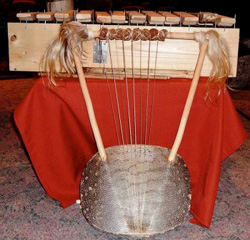
Traditional Ugandan music is disappearing fast. The older generation is passing away, and the younger generation is more attracted to popular music. The society where the traditional music has its deep roots is rapidly changing. Even making some of the traditional musical instruments can now be a challenge. For example, the monitor lizard, whose hide is traditionally used to make the front part of the 8-string ntoogooli in order to produce a slightly scratchy tone quality, is increasingly rare. But Mr. Balikoowa is optimistic about preserving and revitalizing the musical traditions through Uganda’s National Music, Dance, and Drama Festival (NMDDF), of which he is an adjudicator.

The NMDDF, held every summer in Uganda’s capital, Kampala, is a nationwide competition for schools. Actually, it is the final round of a competition whose preliminaries and semi-finals are carried out at various district and regional levels. An award-winning documentary—War Dance—released last year grippingly shows how the festival has helped war-stricken children in Uganda to regain confidence and develop national pride.

For Mr. Balikoowa, the festival encourages the schools to seek out and learn the best of the traditional arts. “We don’t force them. Because it is a competition, the schools make sure that the students do it right. They look for the old people in order to do the right things.”

Collective Effort

Since 2004, with financial and technical support from Vanderbilt University, Mr. Balikoowa has traveled throughout Uganda to record the traditional music for establishing an online database and digital collection of East African music at Vanderbilt’s music library.

A touching story gives a glimpse of the significance of the project. In the early stage of the project, Mr. Holling Smith-Borne, Director of Vanderbilt’s Wilson Music Library, met with Dr. Maria Musoke, the university librarian of Makerere University in Kampala, Uganda, while the latter was visiting in Tennessee. Upon learning about the project, Dr. Musoke told Mr. Smith-Borne that she had been trying for 10 years in vain to look for a song that was sung at her parents’ wedding. “We searched the database and we found two recordings,” said Mr. Smith-Borne at a presentation last month at Vanderbilt. “Hers eyes were filled with water … It was a very emotional moment.”

Vanderbilt University’s online collection, launched in 2007, is the first free online resource of East African music available to anyone around the world and is in steady expansion. Uganda and the other four members of the East African Community (EAC) are on their way to an EAC Common Market, and they are also in the process of consultation in order to form an East African Federation. The economic and political changes being set in motion are bound to have a far-reaching impact on the traditional practices in the countries.

Given the rapid social and political changes ahead for East Africa, much more collective effort will be needed to prevent the traditions of its rich cultural heritage from disappearing and to revitalize those traditions among the younger generations.

Dr. Maria Chow teaches music history and world music at DePauw University.

Photography by Maria Chow

Reprinted with permission

adobe software home best discount prices for full windows 7 ultimate operating system cheap software regcure microsoft office home discount software at discount prices cheap adobe soundbooth cs4 buy adobe dreamweaver cheap buy lotus software minitab software price cheap windows 7 ultimate software windows 7 starter edition cheap easyshare software downloads download norton antivirus 2010 instant again buy microsoft internet keyboard pro buy software faceonbody buy microsoft office 2010 pro plus microsoft buying programs best price on microsoft outlook graphics desktop publishing software download discount adobe illustrator buy used microsoft picture software microsoft office 2007 professional best price buy microsoft office professional plus 2010 buy photoshop cs5 cheap adobe flash software graphics desktop publishing software download buy windows 7 professional 64 bit microsoft vista college discount buy dreamweaver cs5 license best price for microsoft word downloadable digital software discount windows 7 home premium upgrade cheap Adobe Creative Suite 5 Master Collection cheap Creative Suite 5 buy adobe photoshop cs5 online download and get serial # now cheapest price for microsoft office pro adobe acrobat 8 standard discount purchase Adobe CS5 Production online adobe after effects buy adobe education discounts cheap Adobe CS5 Design where to buy Adobe CS5 cheap Creative Suite 5 Design to buy windows 7 cheap Creative Suite 5 Production microsoft government discount microsoft powerpoint 2003 with student discount cheap windows server 2003 download sony vegas pro 10 non profit accounting software prices community health center Adobe Creative Suite 5 Design with discount purchase on line Adobe Creative Suite 5 Production purchase on line Adobe CS5 Design Premium Adobe CS5 Production Premium oem price of Creative Suite 5 cheapest Creative Suite 5 Production Premium Creative Suite 5 Master Collection with cheap price purchase Adobe Creative Suite 5 Design online purchase Adobe CS5 Production on line web store Creative Suite 5 Design Premium best prices on Adobe CS5 purchase online Creative Suite 5 where to buy Adobe Creative Suite 5 buy Creative Suite 5 Master Collection oem buy CS5 Design Premium buy cheap Adobe Creative Suite 5 Production where to buy Creative Suite 5 Web Premium buy Creative Suite 5 Web Premium oem lowest cost Creative Suite 5 Master buy Creative Suite 5 Master online purchase online CS5 Web Premium discount Creative Suite 5 Master purchase Creative Suite 5 Web Premium lowest cost Adobe Creative Suite 5 Web microsoft office+discount windows seven discount for employees where to buy Creative Suite 5 Design Premium symantec discount download dreamweaver cs5 full version download adobe premiere cs4 pro cost of Creative Suite 5 discount microsoft home & student 2010 office 2007 home and student oem adobe photos versions adobe adobe photoshop cs2 downloads adobe essentials 2 ms office suite 2007 office 2007 slo key adobe flash image integrating office 2007 sp1 adobe fllash adobe reader install file buy microsoft office 2003 office 2007 beta activation buy office basic 2007 adobe cs4 plugins adobe lightroom 2 adobe photo effects microsoft office 2007 key gen microsoft office 2007 educator discount download adobe dreamweaver cs3 microsoft office 2007 professional best price buy norton internet security 2010 discount microsoft office pro 2010 microsoft word cheap ca erwin data modeling software cheap microsoft office 2007 plus price buy office 2007 product key replica wathes cheap replica louis vuitton watches ladies replica cartier watches buying microsoft office online buy photoshop software buy photoshop cs4 ms windows software student discount download illustrator cs4 download mp3 software download windows 7 starter edition microsoft office 2007 student discount acrobat 9 pro extended download cheap commercial aluminum windows microsoft office educator discount buy windows 7 ultimate product key online download sony vegas pro 10 dreamweaver buy cheap payroll software software discount prices buy kaspersky internet software uk buy software discount cheap photoshop cs5mac upgrade discount