Well - the Eagles landed, rocked the city from center stage, and took off again!
No, I did not go to the concert. I never heard of the Eagles until the city began to promote their arrival, but did get caught up in the hype.
I read an e-mail interview with the Eagles' singer-drummer Don Henley and was impressed. Henley claims to have been a hippie, and a baby-boomer. I've since logged on to the Internet to listen to some of his music and was moved by songs such as "The End of Innocence" and "The Heart of the Matter." How is it that a dropout hippie could produce such great music and write such haunting lyrics?
You see I'm not of the baby-boom generation, but of the one prior. I was born during the Great Depression and experienced my early adulthood in the 1950s. Known by some as the "Father Knows Best" generation, it was a time when mothers stayed home to care for their five or six kids and dads were respected as head of the household; a time when television ads featured an apron-clad housewife extolling the wonders of a new refrigerator or a new washer and dryer. Our lives in many ways were sheltered and predictable.
We were secure in our beliefs and sure of our destiny. As housewives, our highest form of entertainment was a baby shower or a Tupperware party, and our only cultural exposure was watching Elvis gyrate his hips on a newly acquired black and white television. This sheltered life, however, did not prevent us from keeping an eye on culture and the world around us via books, the media, and the interests of our own children.
The hippie movement in general fascinated me, along with all those long-haired, sandal-clad, bead-strung kids who couldn't stay put. They roamed the highways hitchhiking it seemed to nowhere in particular. They protested, against the war in Vietnam and against the status quo. They played their music in fields, rolled in the mud, and toked. Sure, some abused drugs and sex but others experimented with lifestyles and sought answers to existential questions through Eastern style meditation.
In the chaos of war and racial tensions, they seemingly lost faith in existing social and religious structures and sought enlightenment and peace within themselves. In that sense, not all was lost.
During this time I watched as my own five sons grew out their brush-cuts and sported hair down to their shoulders and tried to keep peace every morning as they fought over their turn to sit under the one hair dryer (mine).
I listened to them learning to play a guitar and to sing songs like "Proud Mary" and "Bad Moon Rising"; listening, I never made any connection to any particular group. I worried over the welfare of my oldest son when he decided to hitchhike all the way to Mexico. What would become of this wandering mass of discontented humanity, everyone wondered.
Charles Reich wrote a book about the hippie movement titled
The Greening of America
. He wrote of "a revolution coming, one that would originate with the individual and eventually change social and political structures as a final act." Would they? Would this young, idealistic generation born of the post-Second World War baby boom change the course of human history?
When Alan Cochrane asked Henley, "where do you look for inspiration?", he replied:
"Books, music, films -- there is so much stuff coming at us these days, it's hard to cut through all the clutter, but a few times a year I will read or hear or see something that just knocks me out. Also, I look to my children, I look inside of myself, I look at the world and, when I can find an unpolluted sky, I look to the heavens. As bad and corrupt as it is, planet Earth is still a miraculous, awe-inspiring place, floating in an unfathomable universe. But I don't think people look up very much anymore. We all seem to be preoccupied with ourselves and our earthly issues, as petty as many of them are. I wish that everybody on Earth could travel up to the International Space Station and look down on this little blue planet. The human race needs a new perspective."
Wow! If this is the philosophy of life that is emerging from mature baby-boomers, there is hope for our world and planet.
It remains to be seen what techie-minded Generation X will "generate" into our world. There are some smart cookies out there in wait of their own time and place in the sun. Will they discover a cure for cancer? Will their new technologies find biological life in space? Will they unravel the mysteries of quantum mechanics and thereby change the course of physics and science? Will they solve the energy crisis? Clean up the planet?
We should refrain from rash judgments of any generation. To be sure there are always negative fallouts to any movement toward change and from the application of new discoveries, but ultimately possibilities for the good of humanity remain limitless.
My own boys, thankfully, turned out great despite my worries; they are productive, creative, sensitive, reflective, and compassionate. I am so very proud of them . . . and of their children. Their hair is now very short and sparse, due to a genetic trait, apparently, and not from sitting under a hair-dryer.
As for my own generation it is now on the way out . . . a dwindling product of bygone days soon to be relegated to its own place in history.
A concert such as The Eagles is not simply a form of entertainment: It is an ongoing cultural expression collectively exposed, to the benefit of both young and old.
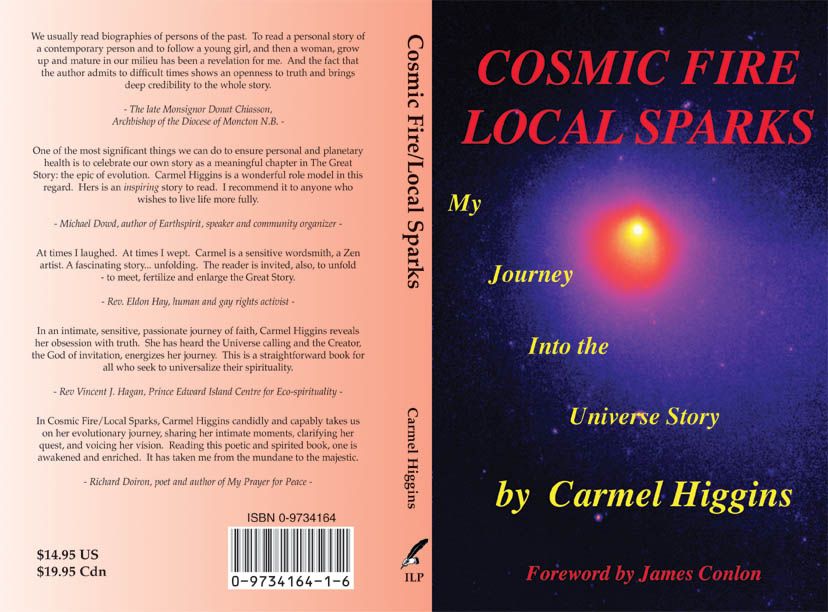 [Carmel Higgins, of Moncton, Canada, holds a certificate in culture and spirituality and is the author of the book Cosmic Fire/Local Sparks: My Journey into the Universe Story. She can be reached via e-mail at
higginsc@rockom.net
]

"Creating is a spiritual act, as well - a kind of meditation. A part of my mind is always writing, always processing what I see and hear and feel, even when I seem to be fully engaged in something else. It's what some philosophers have called 'invisible work.' I can't keep from doing it. I believe that every human being has the creative impulse within them, but if it isn't recognized and developed, then dysfunction and unhappiness is the result. I was lucky. I had great parents who encouraged me and helped my pursue my passion, even though it wasn't exactly what they'd expected."

 Email Us!
 RockOm RSS Feed
 RockOm Facebook
 RockOm MySpace
 RockOm Twitter
 RockOm YouTube
 RockOm Viddler


